September 28, 2026

Nusrat Sarmin
Do you ever feel overwhelmed by the sheer number of content management systems (CMS) available? All promising to be the best, but often seeming like clones of each other?
In this sea of sameness, a hidden gem exists DatoCMS. It might not be the loudest name in the room, but it packs a powerful punch. It's built for the modern web, designed to work seamlessly with the latest technologies like Gatsby, React, and Vue.
But what exactly makes DatoCMS stand out? Is it truly the right fit for your next web project? Let's delve into its world, exploring usability, features, integrations, and how it can empower your next web project.
“It's the headless CMS for the modern web. More than 25,000 businesses use DatoCMS to create online content at scale from a central hub and distribute it via API.” source: DatoCMS
DatoCMS is a cloud-based, headless CMS (Content Management System) designed for flexibility and ease of use. It serves as a robust solution utilized by freelancers, agencies, and startups to empower them in efficiently managing digital content.
This platform excels in its user-friendly interface, fortified security measures, and potent functionality. It also enables teams to effortlessly handle diverse content types and distribute them across various channels.
DatoCMS operates as a Software as a Service (SaaS) headless CMS, contrasting with conventional CMS platforms like WordPress. Unlike these platforms, which tightly bind the frontend presentation layer with the backend, DatoCMS liberates content from its presentation. This separation empowers non-technical users to manage content through a user-friendly web interface, while developers can leverage any technology stack to build the front end.
This segregation also empowers developers to leverage any technology stack for content presentation. And making it particularly well-suited for projects involving contemporary frontend frameworks such as React, Vue, Angular, or static site generators like Gatsby and Next.js.
In essence, DatoCMS emerges as a centralized hub for content management, facilitating streamlined content delivery to any device or platform. DatoCMS is engineered to match the needs of modern developers, offering exceptional flexibility, scalability, and efficiency. Its architecture and features are finely tuned to deliver unparalleled performance in content management and distribution.
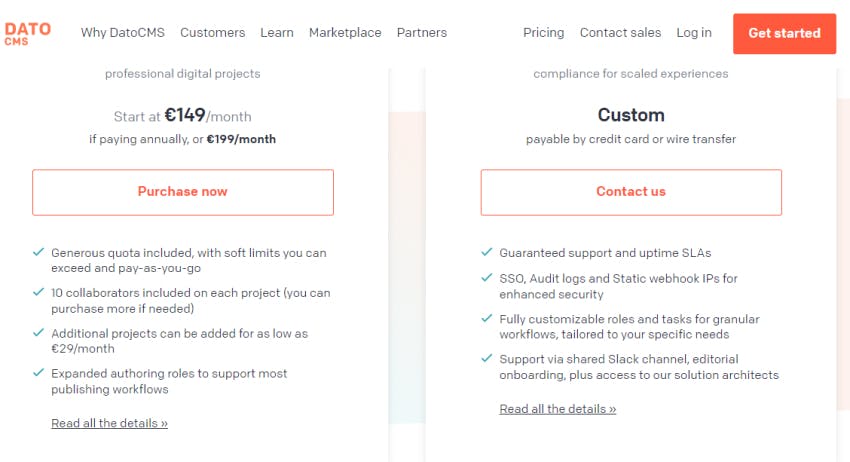
DatoCMS offers a free plan and paid plans. The free plan includes 2 editors, 300 records, 10GB of traffic, and 100k API calls each month. Paid plans offer higher limits and additional features.
In addition to the above, DatoCMS offers a 50% discount for teachers, students, and non-profits. They also offer a 30% discount for agencies through their Partner Program.
Note: This price is subject to change at any time. It is determined by DatoCMS’s policies. You are encouraged to visit their website for up-to-date info.
| Pros | Cons |
|---|---|
|
|
DatoCMS is designed for SMEs, agencies, and lean teams in larger companies. It is a cost-effective alternative to many other CMS platforms, especially when you consider the range of built-in features and capabilities. If you're looking for a headless CMS that is:
Then DatoCMS is definitely worth considering. With a free plan available, there's no reason not to try it out and see for yourself why DatoCMS is the headless CMS that your team will love.
DatoCMS is the best headless CMS (Content Management System) that integrates perfectly with Jamstack architecture. Here's why they work so well together:
Jamstack Explained: Jamstack is a modern approach to web development that prioritizes speed, security, and scalability. It relies on pre-rendered content, APIs, and client-side JavaScript for a dynamic user experience.
Headless CMS in Jamstack: A headless CMS, like DatoCMS, focuses solely on content management. It provides an API for developers to access and deliver content to any frontend framework, fitting perfectly into Jamstack's decoupled architecture.
Benefits of the Combo: This combination offers several advantages:
Decoupling content from presentation solves the frontend problem: your React, Next.js, or Gatsby app queries an API and renders whatever it needs. The next problem showing up on the same roadmap is different. Once AI agents, internal tools, and automation start consuming that same content, an API and a schema for pages isn't enough. You need content structured for machines to reason over, not only for templates to render.
Sanity approaches this as a Content Operating System for the AI era. Content lives in the Content Lake as schemaless JSON, modeled in code and queryable through GROQ, so the same source of truth feeds websites, apps, and agents through one API surface. Sanity Studio gives editors a customizable React workspace over that structure, and the Agent API lets you wire agents and event-driven workflows directly into content operations, with the schema as their context.
The practical difference for a team evaluating headless options in 2026 is scope. A headless CMS gets content to your frontends. Sanity is built to also serve the automations and agents your team will add on top, without a second system to keep in sync.
Not to mention, the landscape of content management is rapidly evolving towards a headless approach, and DatoCMS stands at the forefront of unlocking its full potential. DatoCMS not only simplifies content management but also enhances the overall efficiency and scalability of web applications.
With its comprehensive set of features, ease of use, and focus on performance, it stands out as a leading solution. Whether you are building a small blog or a large, dynamic website, DatoCMS offers the tools and capabilities to streamline your content management workflow. It's designed to excel in a modern web environment, catering to diverse project scales with ease.
Level up your business with a next-gen website!! StaticMania crafts cutting-edge websites using JAMStack, headless CMS, an